The areas of Jaśliski Landscape Park were once inhabited by the Lemkos. Walking through the Park today, you can easily come across remnants of their presence, now serving as attractions of the Low Beskid
LOW BESKID ATTRACTIONS – ABOVE ALL, WILD NATURE
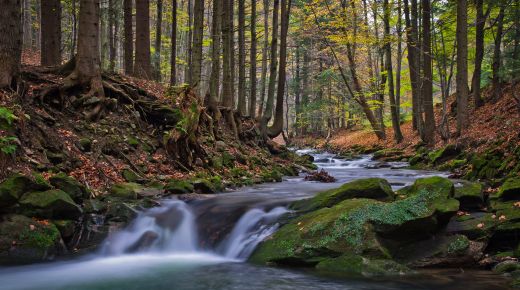
In this landscape park, the upper part of Jasiołka River basin and the source of Wisłok River are protected. The forests, which cover over half of the area, are mainly beech forest. Though firs, hornbeams, and stands of European yew also grow here. The peat bogs here are certainly a unique feature – among the highest located in the entire Low Beskid. In Jaśliski Landscape Park, which lies close to the Magura National Park, you can also encounter animals such as large mammals and birds, including rare ones like the golden eagle or lesser spotted eagle.
In the park's most valuable natural areas, nature reserves have been established, which are popular tourist destinations: “Wadernik,” “Modrzyna,” “Źródliska Jasiołki,” “Przełom Jasiołki,” “Kamień nad Jaśliskami.”
TRACES OF THE LEMKOS IN THE LOW BESKID
The Lemkos who once inhabited the Low Beskid were displaced after World War II. Leaving their homes, they left them just as they were in everyday life. Traces of their presence faded over the years.
Within the park, there are several former Lemko villages. It’s worth visiting them to search for signs of their presence. These include: Czeremcha, Lipowiec, Królik Wołoski, Zyndranowa, Daliowa, Wisłok Wielki, Tylawa, Olchowiec. It’s worth keeping your eyes open there — in some places you can spot roadside crosses, chapels, or remnants of cemeteries. Many religious structures were destroyed. However, masonry churches have been preserved in Wola Niżna, Polany, Tylawa, and Jaśliska. The greatest tourist attractions, however, are the wooden structures — here you can see the former Orthodox church in Olchowiec and the historic architecture of Jaśliska.
In the Jaśliski Landscape Park, you’ll also find the Historic Lemko Cottage in Olchowiec and the Lemko Culture Museum in Zyndranowa. These places continue to preserve the memory of the former inhabitants.
TRAILS IN THE LOW BESKID RUNNING THROUGH THE LANDSCAPE PARK
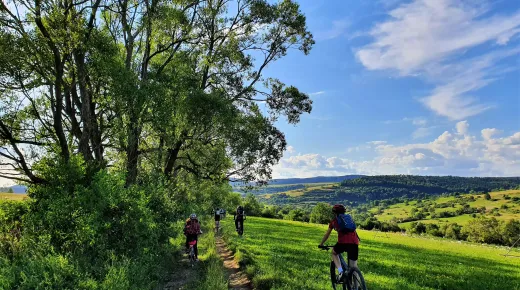
Jaśliski Landscape Park is best explored on foot, and for that purpose, hiking trails have been marked throughout the park. Along the southern border of the Jaśliski Landscape Park — and at the same time along the Polish–Slovak border — runs the red trail. Within the boundaries of the park, it begins at Łupków Pass and leads all the way to the border with Magura National Park. The blue hiking trail follows a very similar route. Both of these options are about 50 km long and allow hikers to reach many border peaks.
The highest peak in the entire Jaśliski Landscape Park is Kamień nad Jaśliskami, which reaches 857 m above sea level. It can be reached from the former Lemko village of Lipowiec, following the green or yellow trail. After covering just over 5 km, you’ll reach the summit, regardless of the trail chosen. This peak is a must-climb for anyone collecting summits from the Crown of the Low Beskid.
Another popular peak within the park boundaries, reachable via trails in the Low Beskid, is Kanasiówka (823 m above sea level). You can reach it by taking the yellow trail from Wisłok Górny. After hiking 5 km, you’ll reach the summit, which is part of the Crown of the Sanok Land.
An interesting attraction, offering a ready-made idea for a trip, is the walking path "Through the Jasiołka Gorge." It starts and ends at the campsite in Stasina. Following it, you can admire the gorge section of the river.
Places worth seeing in the park and the surrounding area:
Tserkov complex in Wisłok Wielki
Former Greek Catholic tserkov in Komańcza
Ciśniańsko-Wetliński Landscape ParkMain
Lemko Culture Museum in Zyndranowa
-
Tourist trail „Along the Hungarian trail”
-
Tourist trail „W przełomie Jasiołki”
photo: M. Puc